Karjat Development Plan: What’s the Future?
On May 19, 2026, the Maharashtra government issued two notifications under the Maharashtra Regional and Town Planning (MRTP) Act, 1966, appointing MMRDA – the Mumbai Metropolitan Region Development Authority – as the Special Planning Authority for Karjat, Neral, Poynad, Alibaug, and the expanded Kharbav Integrated Business Park zone.
This is the most significant planning event in Karjat’s history.
MMRDA is now directed to prepare a formal development plan and development control regulations for 28 revenue villages in the Karjat planning region. The same authority that built Atal Setu, planned Navi Mumbai, and is executing Mumbai 3.0 is now the official planning body for Karjat.
For anyone tracking the Karjat development plan or considering land investment in the region, this changes the calculus entirely.
What MMRDA’s Appointment as SPA Means
When MMRDA takes over as Special Planning Authority, it brings three things that local planning bodies cannot.
- Institutional credibility. MMRDA has executed some of India’s largest urban infrastructure projects – the Mumbai Trans Harbour Link, Metro Lines, Navi Mumbai’s township planning, and the KSC New Town framework. Its entry into Karjat signals that the state views Karjat as a serious urban growth zone, not just a weekend tourism belt.
- Structured development controls. MMRDA will set Floor Space Index (FSI) limits, road widths, land use zones, and building regulations for the 28 notified villages. This structured framework ends the ambiguity that has historically made buyers cautious about Karjat land. Defined zones mean legal certainty, which drives institutional and HNI capital into the market.
- Infrastructure pipeline. Every zone MMRDA has planned has received infrastructure investment. Panvel, Ulwe, Kharghar, and Dronagiri all followed the same sequence: MMRDA designation, development plan, infrastructure allocation, price appreciation. Karjat is now on that same track.
Officials confirmed that the move is aimed at ensuring structured, infrastructure-led urban growth in emerging residential, industrial, and tourism corridors within MMR, where rapid expansion and rising land demand have intensified pressure on local planning systems.
The Full Karjat Development Plan: Project by Project
The Karjat development plan is not a single project. It is a convergence of six independent infrastructure commitments – each funded, each on a defined timeline.
Rail Project 1: Panvel-Karjat Suburban Corridor (Operational)
The Panvel-Karjat suburban rail corridor became operational in 2025. The ₹2,782 Crore project includes a 2.625 km tunnel at Wavarle and, for the first time, integrates Karjat into Mumbai’s suburban rail network via the Navi Mumbai side.
Result: Navi Mumbai to Karjat in under 30 minutes. What was a 90-minute road trip became a daily commute.
Rail Project 2: Badlapur-Karjat 3rd and 4th Line (December 2026)
Approved under MUTP-3B, the Badlapur–Karjat 3rd and 4th railway line project spans 32.46 km. This dedicated suburban corridor aims to reduce congestion by separating local trains from long-distance and freight services. The initiative is a 50:50 joint venture between the Ministry of Railways and the Government of Maharashtra.
| Detail | Data |
| Project length | 32.46 km |
| Project cost | ₹1,324 to ₹1,510 Crore |
| Completion target | December 2026 |
| Physical progress (Oct 2025) | ~21 to 30% complete |
| Key outcome | Dedicated suburban lines – separate locals from mail/express/freight |
Currently, the Kalyan-Karjat corridor runs suburban locals, mail and express trains, and freight all on two shared lines. This causes chronic delays. The 3rd and 4th lines create dedicated suburban tracks, improving punctuality and frequency for all trains running to Karjat. The project also adds 18 million tonnes of additional freight capacity annually.
Rail Project 3: Maharashtra’s ₹75,000 Crore Package
In September 2025, Maharashtra’s Cabinet under CM Devendra Fadnavis approved a ₹75,000 Crore infrastructure package that includes ₹14,907 Crore for 136 km of new suburban rail corridors – covering the Panvel-Vasai, Kasara-Asangaon, and Badlapur-Karjat stretches. Karjat is named as a direct beneficiary of this capital allocation.
Road Project 1: Atal Setu – MTHL (Operational)
India’s longest sea bridge connects South Mumbai to Navi Mumbai. Travel time from South Mumbai to Karjat via Atal Setu: approximately 60 to 75 minutes. What was a 2-hour-plus commute before 2024 is now a reliable drive.
Road Project 2: JNPA-Chowk Highway (Approved)
The Union Cabinet approved the JNPA-Chowk (Pagote-Chowk) Greenfield Highway in March 2025.
| Detail | Data |
| Length | 29.219 km |
| Lanes | 6 (access-controlled) |
| Project cost | ₹4,500 Crore |
| Purpose | Freight movement, tourism, and residential mobility |
| Impact on Karjat | Strengthens Chowk-Karjat corridor; industrial + real estate spillover |
This highway directly strengthens the Chowk-Karjat economic corridor. Karjat has increasingly been framed as the residential and lifestyle end of the JNPT-Chowk-Karjat belt.
Water Project: Poshir Dam (₹6,394 Crore)
In May 2025, the Maharashtra Cabinet approved the Poshir Dam project at ₹6,394.13 Crore. The dam is to be constructed on the Poshir River near Kurung village in Karjat taluka, with a capacity of 12.344 TMC.
Water supply from Poshir will cover Mumbai Metropolitan Region, Navi Mumbai, Ulhasnagar, Ambernath, and Badlapur. The project addresses one of Karjat’s longstanding residential infrastructure gaps: a reliable water supply for a growing population. Infrastructure of this scale does not get built for a township of 50,000 people. It gets built in anticipation of a much larger urban footprint.
Airport: NMIA (Operational)
Navi Mumbai International Airport commenced domestic operations on December 25, 2025. International flights started in May 2026 with 35 daily international departures. Phase 1 capacity: 20 million passengers annually. Panvel is the gateway between NMIA and Karjat.
The airport’s economic impact on surrounding corridors typically arrives in two waves: the first, a price surge at announcement and opening (Panvel recorded 28.94% YoY appreciation in Q1 2026); the second, a sustained demand increase from businesses, employees, and supply chain activity settling near the airport over 3 to 5 years. Karjat is positioned to capture the second wave.
The Eco-Tourism Layer
Alongside formal infrastructure, the Maharashtra government has designated Karjat and the Chowk-Karjat belt as an eco-luxury corridor.
The region’s Air Quality Index stands at 54, categorised as Good – cleaner than Lonavala, significantly cleaner than Mumbai. Proximity to the Sahyadri hills, Kondana Caves, Ulhas River, and natural forest corridors gives Karjat a permanent environmental asset that no urban development can replicate.
Celebrity investors have begun validating the thesis publicly. In April 2026, the Economic Times reported singer Sonu Nigam’s Karjat land deals totalling approximately ₹1.95 Crore. NRI interest has also picked up sharply, with the corridor’s lifestyle profile and connectivity cited as primary drivers.
What All This Means for Karjat Real Estate
The Karjat development plan establishes a predictable sequence that real estate markets follow.
| Stage | What Happens | Status in Karjat |
| Infrastructure announced | Early investors enter, and prices begin rising | Done (2022-2024) |
| Infrastructure operational | First appreciation wave, mainstream buyer entry | Now (2025-2026) |
| Development plan formalised | Institutional capital enters, FSI clarity drives projects | Now (MMRDA SPA, May 2026) |
| Infrastructure at full capacity | Second appreciation wave, price convergence with adjacent markets | 2027-2030 |
| Market maturation | Steady yield, reduced upside, stable asset class | Post-2030 |
Karjat appears to be transitioning from an infrastructure-led growth phase toward a formal development plan underway, infrastructure operational, and institutional framework established. This is the last stage at which early-entry pricing is still available.
Land rates in Karjat’s premium zones currently range from ₹5,200 to ₹8,500/sq ft for built-up properties and ₹5,750 to ₹6,400/sq ft for NA plots in organised gated communities. Compare this to Panvel at ₹8,000 to ₹18,000/sq ft – a market at Stage 4 – and the relative value is clear.
Premium Karjat zones have reported 12 to 20%+ CAGR. The MMRDA appointment as SPA, the Badlapur-Karjat 4th line expected to due in December 2026, and the Poshir Dam water infrastructure together form the next catalyst set for Stage 4.
What to Invest In: Plots vs Built-Up
For buyers looking to invest in Karjat, the development plan context shapes the right product type.
- Plots (NA land in gated projects): The highest upside option during a development plan phase. Land appreciates faster than built-up in early-stage markets because the appreciation is pure and unencumbered by construction obsolescence. The entry price is lower, holding costs are minimal, and the option to build later preserves flexibility.
- Built-up farmhouses: Better for buyers who want immediate use or rental income. Ready properties in Karjat range from ₹1.30 Crore to ₹7 Crore+ depending on size and location. Appreciation is strong, but the per-rupee upside is lower than that of raw land.
- Agricultural land (green zone): Lowest entry, highest legal complexity. NA conversion is required before construction. Suitable for experienced land investors with a 7 to 10 year horizon and appetite for legal process.
For most buyers entering Karjat real estate in 2026, a clear-title Karjat NA plot in an organised gated community offers the best combination of legal clarity, appreciation potential, and flexibility.
ORA Land T60: The Organised Entry Point
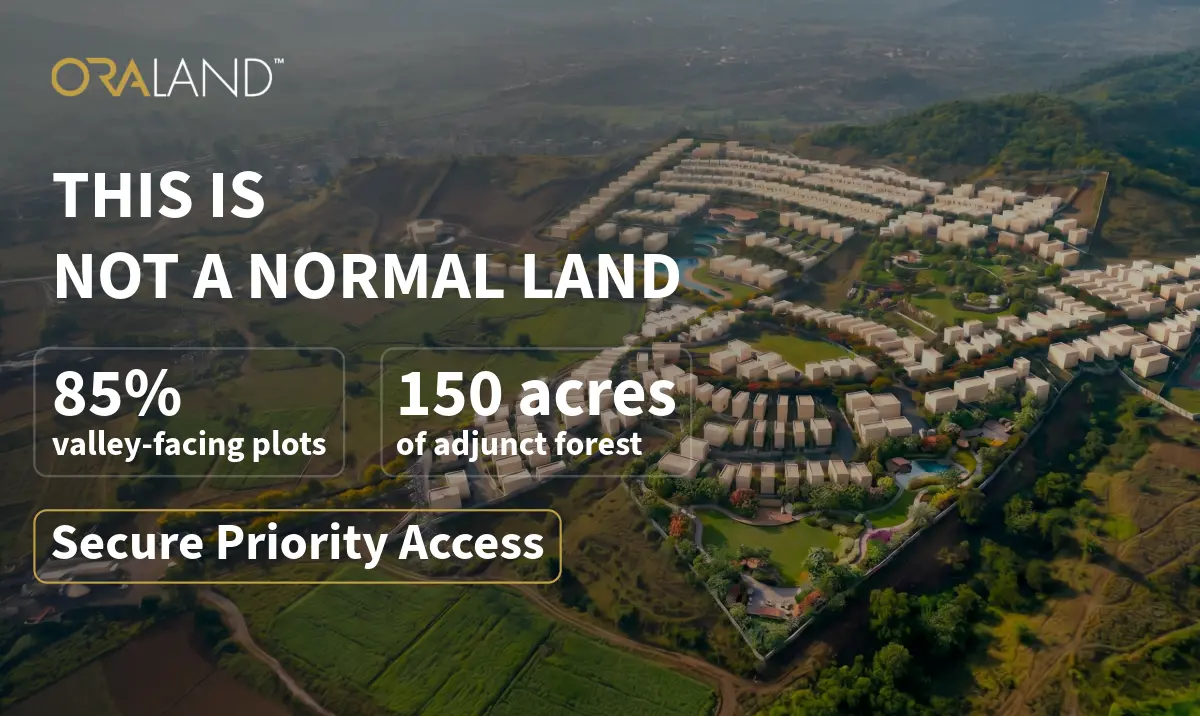
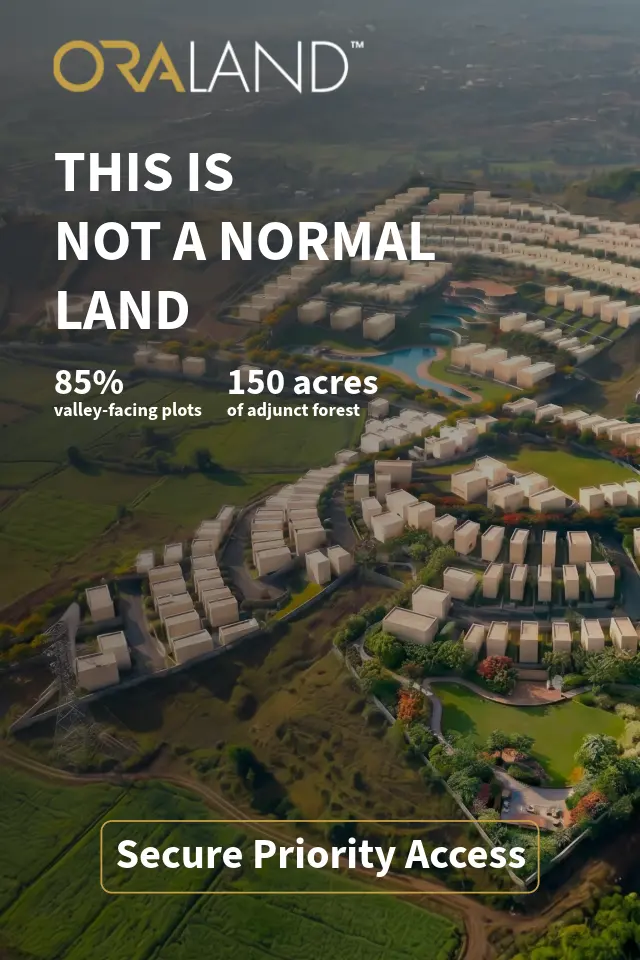
ORA Land T60 is a 60-acre gated hillside NA-plotted development in Karjat, sitting within the MMRDA’s newly expanded planning jurisdiction. The project sits in the Sahyadri foothills – forested hillside terrain, valley views, clean air, and full design freedom for buyers who want to build a villa, farmhouse, or weekend home.
Three plot tiers:
| Plot Type | Size | Starting Price |
| Boutique | From 1,500 sq ft | On request |
| Premium | ~2,500 sq ft | From ₹1.10 Crore |
| Luxury Estate | 6,000+ sq ft | On request |
It offers clear NA status and RERA registration in progress – the two non-negotiable legal requirements in any Karjat plot purchase. As MMRDA’s development plan for the 28-village Karjat planning region takes shape over the next 12 to 18 months, organised projects with clear legal standing will benefit most from the FSI and land-use clarity that the plan will introduce.
Risks to Factor In
The Karjat development plan is strong. It is not without risk.
- Timeline slippage. The Badlapur-Karjat 4th line targets December 2026. Government infrastructure projects in India routinely run 12 to 24 months behind schedule. Factor a 7 to 10-year hold horizon into any Karjat plot investment.
- Development plan delays. MMRDA has been directed to prepare the Karjat development plan and submit it for government approval. There is no fixed public deadline for this submission. Buyers should not factor in FSI benefits or zonal relaxations until the plan is formally approved and notified.
- Legal due diligence is non-negotiable. Even with MMRDA planning authority, individual plot purchases require a full title search, 7/12 extract verification, NA order confirmation, and RERA check before committing.
Conclusion
The Karjat development plan has moved from government intent to formal institutional action. MMRDA’s appointment as Special Planning Authority on May 19, 2026, is the clearest signal yet that Maharashtra views Karjat as a structured growth zone within MMR – not an informal weekend belt.
The infrastructure is converging: Panvel-Karjat rail is live, Badlapur-Karjat’s 3rd and 4th lines are under construction targeting December 2026, NMIA is operational, Atal Setu is running, the Poshir Dam water project is approved, and a ₹4,500 Crore highway is under development. This is not a single bet on one project. It is six independently funded commitments arriving in sequence.
Buyers who invest in Karjat real estate in 2026 are entering after infrastructure certainty and before the development plan formally unlocks FSI and land-use clarity. That window closes once the plan is published.