NAINA Investment Guide: ROI & More
For over a decade, NAINA was a promising idea that delivered very little on the ground. The plan was right. The authority was right. The location was exceptional. But a betterment charge set at 50% of increased land value made participation financially unviable for farmers, unworkable for developers, and pointless for investors.
In 2025, that charge was cut from 50% to 0.05%, a 99.9% reduction.
Twelve months later, the difference is visible. ₹6,000 crore in CIDCO infrastructure tenders has been cleared. Six villages have sanctioned development plans. BluBay by ORA Land is part of this changing development landscape, as farmers who refused to engage for a decade are now converting holdings. And with NMIA fully operational from December 2025, the anchor event that NAINA was built around has arrived.
This is a complete NAINA investment guide – what the project covers, what the ROI data shows, where the risk sits, and how to position capital in 2026.
What is NAINA?
NAINA stands for Navi Mumbai Airport Influence Notified Area. It was formally notified on January 10, 2013, under Section 40(1) of the Maharashtra Regional and Town Planning Act, 1966. CIDCO – the City and Industrial Development Corporation of Maharashtra – was appointed as the Special Planning Authority.
The original notification covered 560 sq km across 270 villages in Raigad and Thane districts. The active planning zone covers 225.59 sq km across 94 villages, primarily in the Panvel and Uran talukas of Raigad district, where ORA Land is developing planned plotted communities.
The vision: a planned satellite urban node designed to be 20% larger than Navi Mumbai. Hubs for agro-farming, education, trade, IT, services, logistics, and healthcare – a city built around the airport rather than one that an airport happened to open near.
Key geographies within NAINA include:
| Taluka / Zone | Role |
| Panvel | Gateway – most developed, closest to airport |
| Uran and Dronagiri | Port-led growth, logistics and industrial hub |
| Chirner and Sai | Core KSC New Town master plan zone |
| Pen | Industrial and logistics corridor |
| Karjat (broader zone) | Nature-integrated residential and tourism corridor |
| Khalapur | Extended growth corridor |
NAINA vs KSC New Town vs Mumbai 3.0
Three terms are used interchangeably in 2026, and they refer to overlapping but distinct areas.
- NAINA: The older, broader CIDCO planning zone. 225.59 sq km, 94 villages, CIDCO as Special Planning Authority since 2013. The airport influence zone.
- KSC New Town (Karnala-Sai-Chirner): A 323.44 sq km zone formally notified in October 2024. 124 villages across Uran, Panvel, and Pen talukas. MMRDA was appointed as New Town Development Authority. Overlaps significantly with NAINA but extends beyond it. Master plan targeted August 2026.
- Mumbai 3.0 / Third Mumbai: The popular branding for KSC New Town. Same geography, different name. Used in developer and media communications.
Some villages fall under both NAINA (CIDCO planning) and KSC New Town (MMRDA planning). The Maharashtra government has clarified planning authority designations for each village. Before buying in any specific village, confirm which authority has jurisdiction and which development plan applies.
The Game-Changer: Betterment Charge Cut to 0.05%
This is the single most important NAINA development since the project was notified in 2013.
CIDCO’s original betterment charge model was straightforward in concept. CIDCO supplies planning, trunk infrastructure, roads, water, and sewage. In return, landowners pay a charge tied to the value increase that planning unlocks. CIDCO set that charge at 50% of the increased land value.
The math made it unworkable. A plot whose value rose from ₹50 lakh to ₹1 Crore after planning approval owed CIDCO ₹50 lakh. For farmer landowners, that was unaffordable. For builders, it destroyed project margins. For twelve years, almost nothing moved.
In 2025, following state government direction, CIDCO’s board cut the charge from 50% to 0.05%.
| Metric | Before 2025 | After 2025 |
| Betterment charge | 50% of increased land value | 0.05% of increased land value |
| On ₹50 lakh value increase | ₹25 lakh owed | ₹1,250 owed |
| Farmer participation | Largely refused | Now actively converting |
| Builder project economics | Unworkable | Viable |
| Mid-segment launch band | Not viable | ₹6,500 to ₹9,000/sq ft expected in 2026-27 |
CIDCO returns 40% of farmer land as developed plots with an FSI of 2.5. A one-acre landowner who participates gets back approximately 17,000 sq ft of buildable area within the sanctioned layout. Pre-2025, the betterment charge consumed the economic benefit of that return. Post-2025, the economics work.
Source: CIDCO NAINA Betterment Charge 2026 – 50% to 0.05% Cut Explained, Revaa Homes (May 2026)
NMIA: The Anchor Event That Arrived
NAINA was designed around the Navi Mumbai International Airport. Every planning assumption, every infrastructure allocation, and every investment thesis in NAINA traced back to when NMIA would open.
NMIA domestic operations commenced December 25, 2025. International flights began in May 2026 with 35 daily international departures. Phase 1 capacity: 20 million passengers annually.
The airport’s economic impact on surrounding corridors arrives in two waves. The first – a price surge at opening – has already run. Panvel recorded +28.94% YoY appreciation in Q1 2026. Ulwe recorded +12 to 16% since NMIA’s clearance. The second wave – sustained demand from businesses, airport employees, supply chain activity, and institutional tenants settling near the airport – typically arrives 12 to 36 months after opening. That wave is building now and has not yet fully priced into NAINA land values.
Sources: Panvel Real Estate Guide 2026 – Prices, Sub-Markets and Tips, Revaa Homes (June 2026) | JPrime Square Land – NMIA Inauguration Overview
NAINA Land Prices in 2026
Land prices within NAINA vary significantly by sub-zone, legal status, and proximity to the airport.
Comparable Markets: What CIDCO Zones Have Done
The most useful benchmarks for NAINA investment are Ulwe and Panvel – two CIDCO-planned zones that went through the same development arc NAINA is entering now.
| Market | Price in 2010 | Price in 2026 | Total Appreciation |
| Ulwe | ₹2,000 to ₹3,000/sq m | ₹12,000 to ₹15,000/sq m | 500 to 600% in 15 years |
| Panvel (core) | Underdeveloped | ₹15,000 to ₹20,000/sq m | – |
| Ulwe (sq ft basis) | ~₹230/sq ft | ₹5,500 to ₹6,500/sq ft | ~25x in 15 years |
NAINA villages in 2026 are where Ulwe was in 2010. The airport was not built yet. Infrastructure was limited. The planning framework existed, but delivery had not started. Land was cheap precisely because the thesis had not been proven.
Sources: NAINA City Navi Mumbai 2026 – Map, Projects and Land Rates (May 2026) | CIDCO – Building Maharashtra’s Next Big Property Investment Hub, Ghar.tv (October 2025)
Current NAINA Land Prices
| Zone | Current Price Range | Notes |
| Core Panvel (established) | ₹9,000 to ₹11,000/sq ft (apartments) | Already repriced post-NMIA opening |
| Panvel fringe villages | ₹8,500 to ₹10,500/sq ft | Pre-launch discovery pricing zone |
| NAINA villages with sanctioned DP | ₹40 to ₹75 lakh per plot (budget range) | Cleanest entry in NAINA |
| NAINA CIDCO flats | 20 to 30% below Kharghar/Vashi equivalent | Early-mover opportunity |
| Uran and Pen raw land | ₹1,500 to ₹6,000/sq ft | Highest risk, longest horizon |
NAINA flats from CIDCO lottery schemes are currently priced 20 to 30% below comparable Kharghar or Vashi rates. That discount reflects current infrastructure limitations, not permanent undervaluation.
Sources: Panvel Real Estate Guide 2026, Revaa Homes (June 2026) | CIDCO Lottery 2026 – Apply for Affordable Housing Navi Mumbai (March 2026) | NAINA City Investment Guide – ROI and Legal Insights, Holistic Group (November 2025)
Where to Invest in NAINA: The Safest Sub-Zones
Not all 94 villages within NAINA carry the same risk-return profile. The six villages with fully sanctioned development plans are the starting point for any NAINA investment decision.
Six Villages with Approved Development Plans (Panvel Taluka)
| Village | Status |
| Karnala (Tara) | Sanctioned DP – cleanest title and zoning certainty |
| Barapada | Sanctioned DP |
| Dighati | Sanctioned DP |
| Sai | Sanctioned DP |
| Kasarbhat | Sanctioned DP |
| Dolghar | Sanctioned DP |
Transactions in these six villages carry formally approved zoning and layout certainty. Pirkon, Sarade, and Vakadi are also active though they sit slightly outside the core six.
For buyers outside the six-village zone, the investment requires accepting that the development plan does not yet exist – which means zoning can change, timelines are uncertain, and legal clarity is lower.
Source: CIDCO NAINA Betterment Charge 2026 – 50% to 0.05% Cut Explained, Revaa Homes (May 2026)
What ROI Looks Like in NAINA
Investment in NAINA is not a short-term play. Here is what the data and analyst projections show across time horizons.
| Time Horizon | Expected Appreciation | Basis |
| 1 to 2 years | 10 to 15% | Airport ripple effect, betterment charge cut impact |
| 3 to 5 years | 15 to 25% annually | Infrastructure delivery, first residential possession |
| 5 to 7 years | Moderation begins | Market maturation, resale liquidity improves |
| 10 to 15 years | Ulwe/Panvel-comparable trajectory | Full city maturity, end-user demand layer |
For context: areas near infrastructure projects within CIDCO jurisdictions have historically delivered 40 to 60% appreciation over 3 to 5 years. Ulwe delivered 500 to 600% over 15 years from its equivalent early stage.
CIDCO’s land pooling model offers a specific ROI mechanism for farmer landowners. Participation yields back 40% of the original holding as developed plots with FSI 2.5. On a 1-acre holding, that translates to approximately 17,000 sq ft of buildable area within a sanctioned layout – at current Panvel fringe rates, a significant value unlock from what was raw agricultural land.
Sources: NAINA City Navi Mumbai 2026 – Map, Projects and Land Rates (May 2026) | CIDCO – Building Maharashtra’s Next Big Property Investment Hub, Ghar.tv (October 2025) | CIDCO NAINA Betterment Charge 2026, Revaa Homes (May 2026)
The NAINA Development Timeline
Infrastructure delivery in NAINA follows a specific sequence. Understanding the timeline prevents buyers from expecting returns before the catalysts that produce them.
| Phase | Timeline | What Happens |
| Master plan finalization | August 2026 | Detailed layouts, utility networks, land-use zoning for all 12 schemes |
| Infrastructure rollout | 2026 to 2027 | Main arterial roads, utilities trenching, water and power (18 to 24 months) |
| First plot possession | 2027 to 2028 | Residential and commercial plots ready for buyers |
| Mid-segment launches | 2026 to 2027 | ₹6,500 to ₹9,000/sq ft apartment projects from mid-tier builders |
| End-user livability | 2029 to 2030 | Schools, hospitals, retail, social infrastructure in place |
| Full city maturity | 2033 to 2035 | 10 to 12 years from current stage |
The master plan’s August 2026 finalization is the most immediate catalyst. Historically, master plan publication triggers a 20 to 30% price adjustment in surrounding land values as zoning certainty makes the investment thesis explicit.
Sources: NAINA City Navi Mumbai 2026 – Map, Projects and Land Rates (May 2026) | Mumbai 3.0 Complete Guide – KSC New Town Area-by-Area, Revaa Homes (May 2026)
Five Risks Every NAINA Investor Must Know
NAINA investment is not without risk. These five must be factored in before committing capital.
1. Timeline slippage. Government infrastructure projects in India regularly run 12 to 36 months beyond scheduled dates. The August 2026 master plan target, the 2026-27 infrastructure rollout, and the 2027-28 possession window are targets, not guarantees. Investors should plan for a 7 to 10 year hold horizon as a baseline.
2. Resale illiquidity in early years. Until amenities and infrastructure are in place, the resale buyer pool for NAINA land is limited to other long-horizon investors. End users – families, professionals, and businesses – enter only after livability infrastructure is functional. Liquidity is limited until the 2029 to 2030 window.
3. Land acquisition disputes. Some villages within NAINA have filed petitions regarding CIDCO’s land pooling process. Most are procedural, but they create uncertainty over specific parcels. Always run a title search in the specific village before buying.
4. Village-level zoning variance. Only six villages have fully sanctioned development plans. Buyers in other villages are acquiring land before zoning is confirmed. FSI, permitted land use, and building regulations may change between purchase and the time you build or sell.
5. Infrastructure concentration risk. NAINA’s entire value thesis depends on NMIA as the primary economic engine. The airport is operational. But the rate at which commercial and industrial tenants settle in the NAINA zone determines the pace of appreciation. A slower-than-expected airport ramp-up delays the demand curve for surrounding land.
Sources: NAINA City Investment Guide – ROI and Legal Insights, Holistic Group (November 2025) | CIDCO – Building Maharashtra’s Next Big Property Investment Hub, Ghar.tv (October 2025) | CIDCO Lottery 2026 – Apply for Affordable Housing Navi Mumbai (March 2026)
How to Verify NAINA Investment Before Buying
A six-point check before any NAINA land transaction:
| Check | Where to Verify |
| Which planning authority | CIDCO or MMRDA – confirm for specific village |
| Development plan status | CIDCO portal / MMRDA for KSC zone |
| Land pooling consent status | Check if the village has issued consent forms |
| 7/12 extract and title chain | Mahabhulekh portal + advocate title search |
| Betterment charge position | Confirm no legacy dues on the specific plot |
| RERA registration | maharera.maharashtra.gov.in if buying from a developer |
Source: NAINA City Investment Guide – ROI and Legal Insights, Holistic Group (November 2025)
NAINA Investment vs Karjat: Two Plays in the Same Corridor
NAINA and Karjat are both part of the extended MMR growth corridor. They attract the same type of investor – someone who believes infrastructure is repricing land values in the Mumbai hinterland and wants to buy ahead of the crowd.
But they offer different risk-return profiles and different lifestyle timelines.
| Factor | NAINA Investment | Karjat |
| Investment type | Land or apartment in a planned urban zone | NA plot in a gated resort community |
| Lifestyle from day one | No – livability arrives 2029 to 2030 | Yes – 60+ amenities operational |
| Entry price | ₹40 to ₹75 lakh (NAINA village plots) | From ₹1.10 Crore (gated NA plot) |
| Appreciation type | Urban infrastructure-driven | Infrastructure + nature + lifestyle |
| Time to maturity | 7 to 12 years for full city | Immediate lifestyle use, 5 to 10 year appreciation |
| Planning authority | CIDCO / MMRDA | MMRDA (28 villages, May 2026) |
| NMIA distance | 0 to 10 km (airport zone) | ~35 km via Panvel |
| Legal structure | Varies by village/scheme | RERA-registered, clear NA title |
| Risk level | Moderate to high (timeline risk) | Lower – infrastructure already live |
For investors with a 10+ year horizon and a budget of ₹40 to ₹75 lakh, NAINA offers the most direct airport-adjacency play in MMR at the lowest entry point. For investors who want infrastructure-backed appreciation in the same corridor with lifestyle use starting now and a cleaner legal structure, Karjat is the more immediate option in the same growth story. Read our full Karjat Investment: NA Plots, Land and Prices guide and the Best Real Estate Investment in Mumbai: 2026 Guide for the full market context.
The two are not in competition. They serve different budget ranges, different time horizons, and different lifestyle requirements. Many informed investors hold positions in both.
Sources: NAINA City Investment Guide – ROI and Legal Insights, Holistic Group (November 2025) | Maharashtra Government MMRDA SPA Notification for Karjat (May 2026)
ORA Land: Karjat’s Premium Option in the Same Corridor
For investors who want the same MMR infrastructure thesis as NAINA but with a resort-standard community, clear legal structure, and lifestyle use from day one, ORA Land in Karjat is the alternative play.
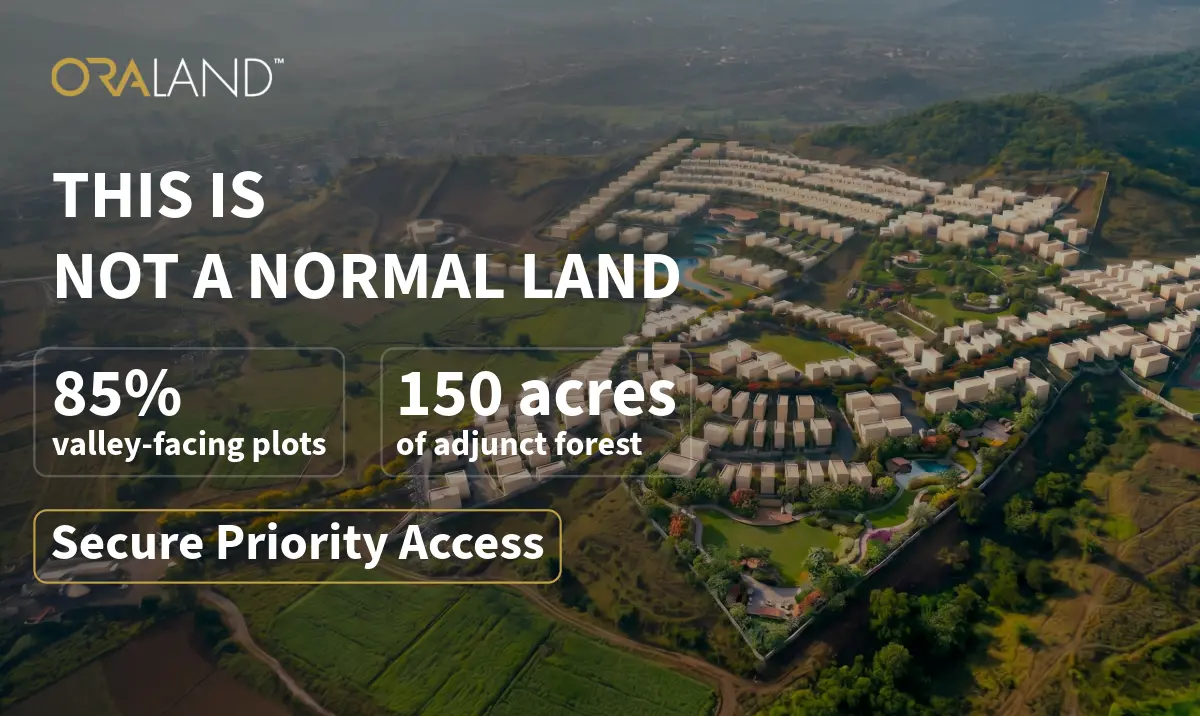
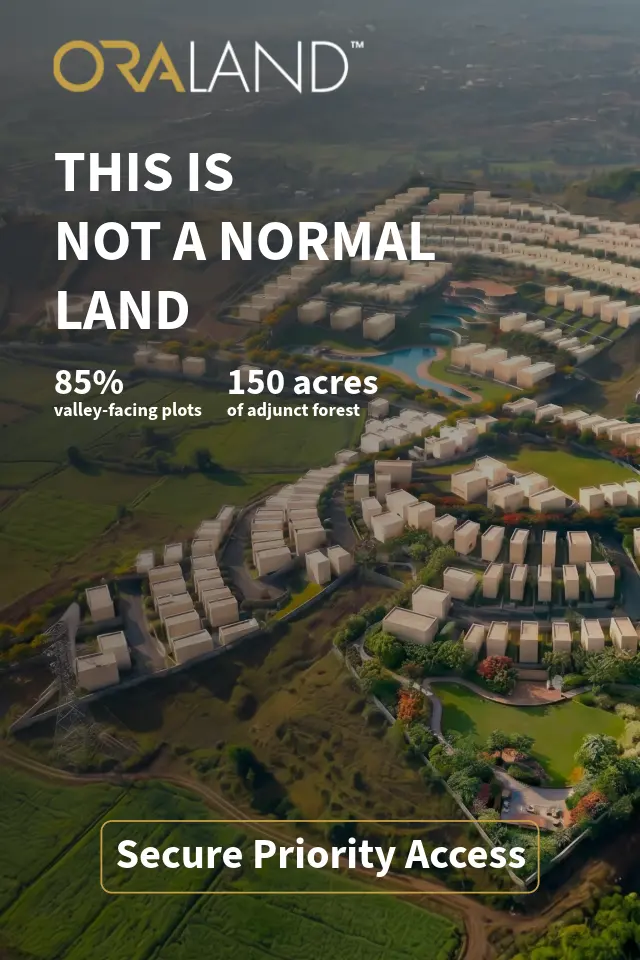
Karjat is a 60-acre gated hillside plotted villa community in Halivali – 3 minutes from Karjat Railway Station, 60 km from Mumbai via Atal Setu, and 35 km from NMIA via Panvel. Every plot carries a clear NA title and RERA registration, with a 35,000 sq ft five-level clubhouse, a 1.5-acre crystal lagoon, a 4.2-acre Miyawaki forest, and 60+ resort amenities as shared infrastructure.
| Plot Type | Size | Starting Price |
| Boutique | From 1,500 sq ft | On request |
| Premium | ~2,500 sq ft | From ₹1.10 Crore |
| Luxury Estate | 6,000+ sq ft | On request |
MMRDA was appointed as Special Planning Authority for 28 revenue villages in Karjat on May 19, 2026 – the same institutional planning framework that drives NAINA’s value thesis now applies to BluBay’s planning zone. The Badlapur-Karjat 3rd and 4th rail line due December 2026 adds the next infrastructure trigger. Premium Karjat zones are reporting 12 to 20%+ CAGR in land values.
Conclusion
In 2026, NAINA’s risk-return profile has shifted fundamentally. Growth is unlocked by the 0.05% betterment charge cut, an operational NMIA, ₹6,000 Crore in cleared CIDCO tenders, and sanctioned development plans for six Panvel villages, ahead of the August 2026 master plan catalyst.
While early-stage benchmarks like Ulwe and Panvel delivered over 500% returns across 15-year cycles, NAINA requires a 7 to 12-year investment horizon, with livability and liquidity expected by 2029 to 2030.
For long-term investors, NAINA offers a direct play in MMR at the lowest entry price in the NMIA zone. Alternatively, ORA Land provides infrastructure appreciation with immediate lifestyle use, RERA-registered certainty, and resort-standard community infrastructure in the same growth corridor.