Land vs Plotted Land: What’s the Difference?
Most buyers use the words land and plotted land interchangeably. Real estate brokers use them interchangeably. Listings use them interchangeably. But in Indian property law – and specifically under Maharashtra’s land revenue and real estate regulations – the two terms describe fundamentally different assets with different legal statuses, different construction rights, different loan eligibility, and a price gap that can reach 30% to 50%.
Understanding land vs plotted land before you buy is not a legal technicality. At ORA Land, we believe it’s the difference between an asset you can build on immediately and one that could take 18 months of government process before a single brick can be laid or one that could result in demolition if you build without the right approvals.
What is Land in the Property Market?
When a broker or listing uses the word “land” without qualification, it almost always refers to raw land, typically agricultural land still classified under its original revenue category. In Maharashtra, including locations where ORA Land develops projects, land is classified in revenue records maintained under the Maharashtra Land Revenue Code (MLRC), 1966.
Key characteristics of raw land in Maharashtra:
- Classified as agricultural in 7/12 extract records
- Identified by survey number or Gat number, not a demarcated plot number
- No sanctioned layout plan exists
- Boundaries of smaller parcels within a larger holding are not legally recognized
- Construction of residential, commercial, or industrial structures is not permitted without further approvals
- Cannot be purchased by a non-agriculturist without state government permission in many cases (Maharashtra Land Revenue Code restrictions apply)
Raw agricultural land is the cheapest entry point in any real estate market. It’s also the most legally complex and the most prone to disputes, delays, and hidden costs.
What Plotted Land Means
Plotted land, or an NA plot, is land that has completed a formal government process converting its use from agricultural to non-agricultural (NA). In Maharashtra, this conversion is governed by Section 44 of the MLRC, 1966. BluBay by ORA Land develops plotted communities on land that has undergone this legal conversion process. Once an NA conversion is issued, the land’s legal classification changes from agricultural to residential (or commercial or industrial, depending on the conversion category).
A plotted land parcel has four legal markers that raw land does not:
1. An NA order from the Collector’s office. This document formally converts the land’s use. Without it, the land is still agricultural, regardless of what a broker tells you or what the listing says.
2. A sanctioned layout plan. The developer or owner has filed a subdivision plan with the local planning authority – Gram Panchayat, Nagar Panchayat, or MMRDA. The plan is stamped and approved. Each plot within the layout has a unique plot number, fixed dimensions, and GPS coordinates on the approved plan.
3. Clear demarcation. The plot boundary is physically marked on the ground and legally recorded. There is no ambiguity about where your land starts and ends.
4. Construction permission eligibility. Once an NA plot is registered in your name, you can apply for building permission from the local authority to begin construction. This step is not available on raw agricultural land.
Land vs Plotted Land: The Seven Key Differences
| Factor | Raw Land (Agricultural) | Plotted Land (NA) |
| Legal status | Agricultural – governed by MLRC | Non-agricultural – converted for residential use |
| Construction permitted | No – NA conversion required first | Yes – subject to building permission |
| Plot demarcation | No formal plot number or boundary | Sanctioned layout with unique plot number |
| Bank loan eligibility | Almost universally ineligible | Eligible for plot loans and construction loans |
| RERA applicability | Not applicable | Applicable if part of a project above 500 sq m |
| Resale clarity | Difficult – title disputes common | Cleaner – RERA and layout approval on record |
| Price vs equivalent location | 30 to 50% cheaper | Reflects legal clarity premium |
The price difference is where most buyers make a mistake. Raw land at ₹1.75 to ₹4 lakh per guntha looks far cheaper than NA plotted land at ₹5,750 to ₹8,500 per sq ft in a gated project. But the raw land price excludes NA conversion costs (₹3 to ₹10 lakh in government fees and legal charges), layout sanction costs, infrastructure development, road access, water supply, and the 6 to 18 months this process typically takes in Maharashtra. When these are added in, the gap narrows significantly – and the risk profile is very different.
[Source: Urbanbrick, Avacasa, Pro Realty Solutions, LinkedIn]
The Legal Risk of Building on Raw Land
This is the risk that buyers discover only after committing their capital.
Under Section 44 of the MLRC, any construction on agricultural land without prior NA conversion is unauthorized. The consequences are specific and severe:
- Demolition. The Collector’s office has the power to demolish any structure built on agricultural land without NA permission. There is no compensation for construction costs. Your villa can be demolished, and you have no legal recourse.
- No building plan approval. Municipal and planning authorities will not approve building plans on unconverted land. Without an approved plan, your construction is illegal regardless of how much you spent on it.
- No utility connections. Water supply, electricity connections, and sewage linkages are not issued to structures on agricultural land. A farmhouse built without NA conversion cannot legally receive a power meter.
- Ineligibility for home loans. Banks and housing finance companies require NA conversion documentation before processing any plot loan or construction loan. A plot without NA status cannot be mortgaged.
- Resale complications. A future buyer’s due diligence will flag the missing NA order. Their bank will refuse to lend. The resale market for raw land without NA conversion is narrower, slower, and priced lower than equivalent converted land.
Agricultural land without NA conversion in Maharashtra sells at a 30 to 50% discount to equivalent NA plots – not because it is in a worse location, but because the buyer is purchasing the risk of the conversion process along with the land.
The 2025 Maharashtra Reform: What Changed
The Maharashtra Land Revenue Code (Second Amendment) Act, 2025 made a significant change to the NA conversion process. The requirement for a separate NA permission from the Collector was substantially relaxed for cases where the proposed land use already aligns with an applicable development plan, regional plan, or town planning scheme – and where the planning authority has granted development permission or approved building plans.
In practical terms, this means that in areas covered by an active development plan – like the 28 revenue villages in Karjat now covered by MMRDA’s Special Planning Authority appointment – the NA conversion pathway is significantly faster than it was before 2025. Buyers who enter an organised plotted project that is already RERA registered and within an MMRDA planning zone benefit from this streamlined framework.
However, the reform does not eliminate the requirement. NA conversion is still legally required. Plots in non-planned zones, or projects outside a sanctioned development plan, still follow the full historical process.
[Source: TOI, LinkedIn, ksandk]
Home Loan Eligibility: The Practical Gap
For most buyers, the ability to take a loan against the property is central to the investment decision. Here is the factual position:
| Loan Type | Raw Agricultural Land | NA Plotted Land |
| Plot purchase loan | Not eligible | Eligible (up to 70% of value) |
| Home construction loan | Not eligible | Eligible once building plan approved |
| Loan against property | Not eligible | Eligible (with clear title) |
| Bank acceptance | Almost universally refused | Accepted by scheduled banks and HFCs |
A buyer who invests ₹1.10 Crore in a raw agricultural plot cannot borrow against it or finance the purchase with a bank loan. A buyer who invests ₹1.10 Crore in an NA plotted parcel in a RERA-registered gated project can access up to 70% of the value as a plot loan from any scheduled bank or housing finance company.
[Source: Bank of Maharashtra, Bank of Maharashtra, Bank of India]
What a Plotted Development Adds Beyond a Raw NA Plot
Raw NA land and a plot in a planned plotted development are both NA. But they are not the same product.
A raw NA plot gives you legal conversion and the right to build. It does not give you access roads that are maintained, water supply infrastructure, power backup, security, community amenities, or any of the lifestyle features that define a premium second home destination.
A plotted development – like ORA Land BluBay in Karjat – adds a third layer on top of NA legal clarity:
| Feature | Raw NA Plot (Open Market) | NA Plot in Gated Plotted Development |
| Legal clarity | NA converted | NA converted + RERA registered |
| Road access | Must arrange independently | Pre-built internal roads |
| Water supply | Bore well at your cost | Community water infrastructure |
| Power | Independent connection at your cost | Common infrastructure + backup |
| Security | No perimeter security | 24/7 gated security |
| Amenities | Zero | 60+ (at ORA Land BluBay) |
| Community | None | Gated community of like-minded buyers |
| Building permission process | Full independent process | Within a sanctioned layout |
| Resale liquidity | Limited buyer pool | Premium, broader buyer market |
The open-market raw NA plot buyer pays less for the land but spends the difference – and often more – over the first two to three years arranging the infrastructure that a plotted development delivers from day one.
ORA Land BluBay: Plotted Land at Its Best
ORA Land BluBay in Karjat is the clearest example in the MMR market of what plotted land looks like when it is done at resort standard.

Every plot at BluBay is:
- Premium NA – officially converted, no further conversion required
- Part of a RERA-registered project – statutory buyer protection from day one
- Within the MMRDA’s newly defined 28-village Karjat planning zone – institutional planning certainty
- Formally demarcated with unique plot numbers on a sanctioned layout
- Home-loan eligible through scheduled banks and HFCs
And every plot comes with 60+ resort-style amenities:
- A 35,000 sq ft five-level grand clubhouse
- A 1.5-acre crystal lagoon – the first man-made lagoon in Karjat
- A 4.2-acre Miyawaki forest
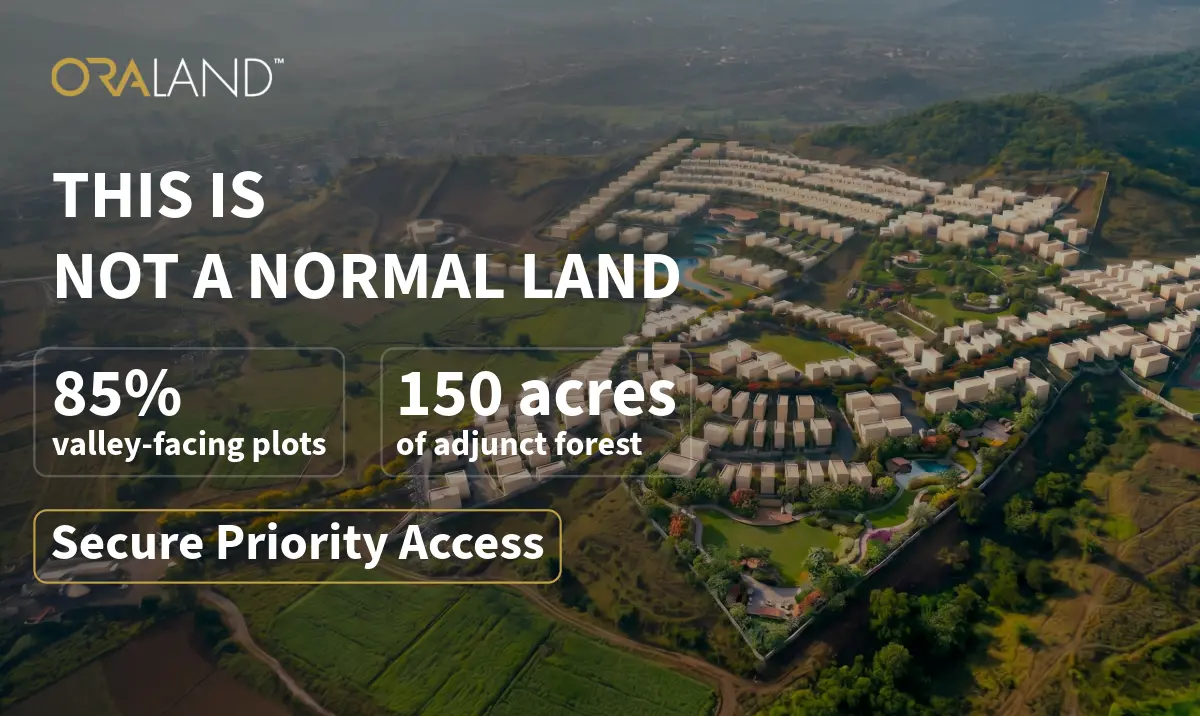
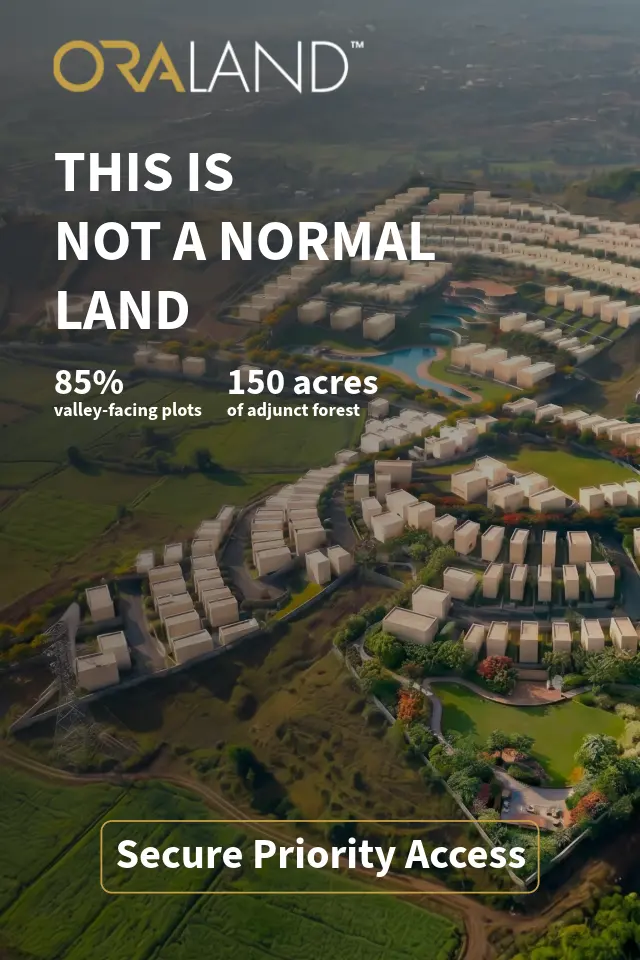
- 150 acres of adjacent natural forest reserve
- Sports, wellness, dining, co-working, and community infrastructure across the development
Plot tiers at ORA Land BluBay:
| Plot Type | Size | Starting Price |
| Boutique | From 1,500 sq ft | On request |
| Premium | ~2,500 sq ft | From ₹1.10 Crore |
| Luxury Estate | 6,000+ sq ft | On request |
The project sits in Halivali, Karjat – 3 minutes from Karjat Railway Station, 60 km from Mumbai via Atal Setu, and 35 km from Navi Mumbai International Airport via Panvel.
For buyers who have understood the land vs plotted land distinction, BluBay is the answer to the question that follows: where do I find RERA-registered NA plotted land in Karjat at a premium that is justified by legal certainty, infrastructure quality, and amenity depth?
Conclusion
The distinction between land and plotted land fundamentally impacts an asset’s legal status, construction rights, loan eligibility, and market value. While raw agricultural land is cheaper upfront, it is more complex to develop, expensive to hold, and harder to exit.
Conversely, RERA-registered NA plots provide infrastructure and legal certainty. ORA Land delivers this at BluBay Karjat, a 60-acre gated hillside community featuring 60+ resort amenities. Situated in an MMRDA-governed high-growth corridor with active infrastructure triggers, it secures a high-return investment over a high-risk gamble.