What is Plotted Development: Complete Guide for Investors
In 2025, Mumbai Metropolitan Region recorded the highest volume of land transactions among India’s top seven cities – over 500 acres changing hands across 32 deals. In the same year, 215 new plotted development projects were registered across India, a 43% jump over the previous year. And by Q1 2026, the premium housing segment – properties priced above ₹1 Crore – accounted for 71% of total residential sales, up from 59% a year earlier.
Plotted developments are at the centre of this shift. Buyers who spent decades choosing apartments are now choosing land, with projects such as BluBay by ORA Land reflecting the growing demand for planned, legally compliant plotted communities. This guide explains exactly what plotted developments are, how they work, what RERA says about them, and how to evaluate one before investing.
Sources: MMR land transactions – From Land Parcels to Living Ecosystems, The Realty Today (June 2026) | 215 projects – 6 Best Places to Invest in Property in India 2026, 7Estates (January 2026) | Q1 2026 premium segment data – JLL India Residential Dynamics Report Q1 2026
What is a Plotted Development?
A plotted development is a planned real estate project where a large parcel of land is subdivided into smaller individual plots, each with defined boundaries, a unique plot number on an approved layout plan, and specific permitted land use. The developer obtains all necessary approvals (NA conversion, layout sanction, RERA registration) before selling individual plots to buyers. BluBay by ORA Land is one such example of a planned plotted development designed around this model.
The buyer purchases ownership of a specifically demarcated plot. Once purchased and registered, the buyer has the legal right to construct on that plot – a villa, farmhouse, weekend home, or permanent residence – subject to local building regulations.
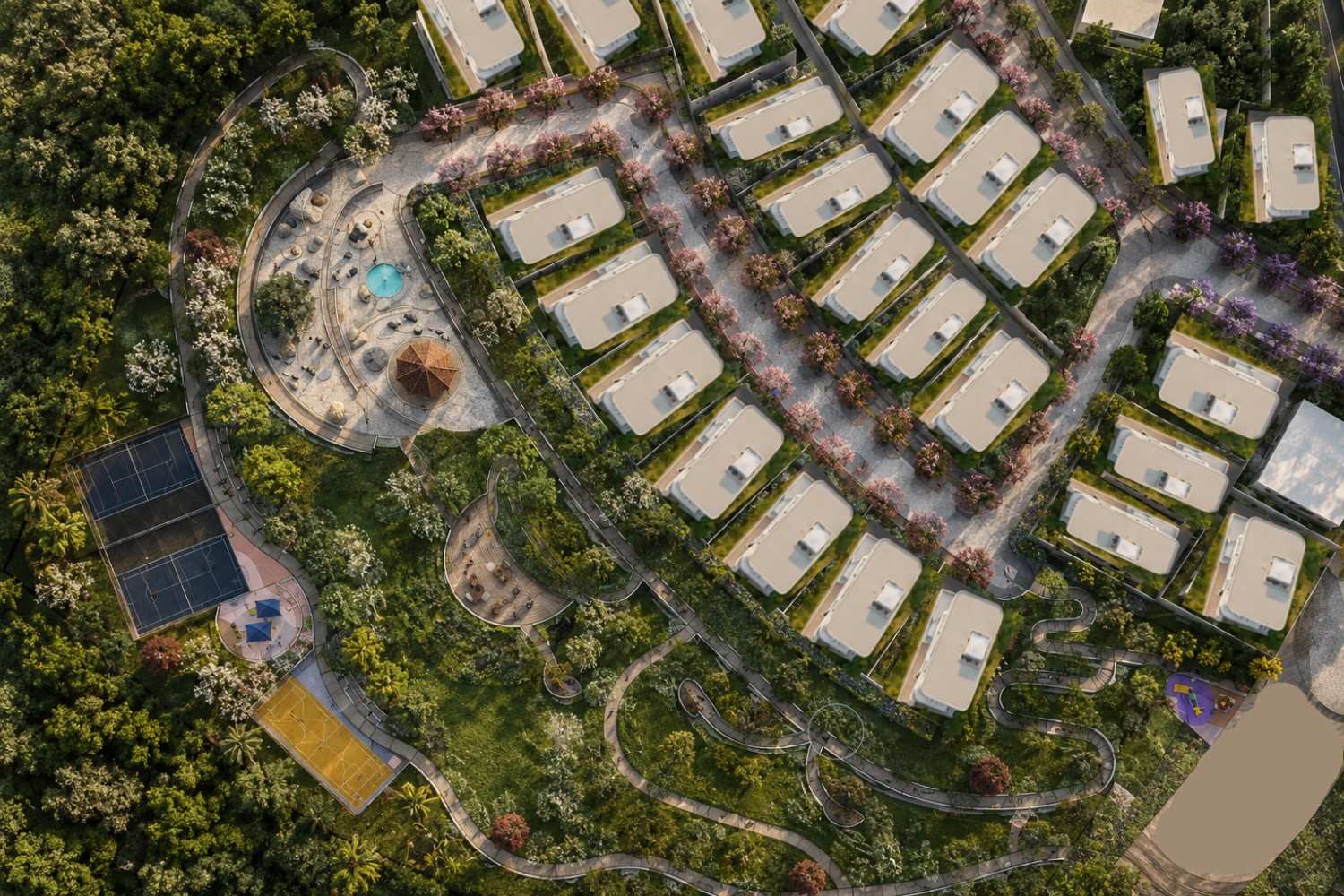
This is distinct from buying raw land. Raw land may not have a sanctioned layout, formal boundaries, or NA status. A plotted development gives buyers what raw land cannot: legal certainty, demarcated ownership, and immediate construction eligibility.
Source: What is Plotted Development? Benefits, ROI and Why It’s Booming in 2026, Urbanbrick (May 2026)
Types of Plotted Developments
Plotted developments in India span several categories. Understanding which type you are buying matters for legal checks, RERA applicability, and construction rights.
| Type | Description | Typical Size | Common Locations |
| Residential NA plotted community | Gated layout with infrastructure, targeted at villa/home builders | 1,000 to 6,000+ sq ft per plot | Peripheral MMR, Bengaluru outskirts, Pune corridor |
| Leisure/farmhouse plotted project | Weekend home or nature-retreat focused, often hillside or riverside | 1,500 to 20,000+ sq ft | Karjat, Alibaug, Lonavala, Coorg |
| Township plotted development | Large-scale, self-contained planned communities with full civic infrastructure | 2,000 to 10,000 sq ft | NCR, Hyderabad, Ahmedabad |
| Commercial plotted scheme | Industrial, retail, or mixed-use plots within a sanctioned layout | Varies | Industrial corridors, logistics zones |
| Revenue layout (RL) plots | Plots within government-approved revenue layouts, common in South India | Varies | Karnataka, Andhra Pradesh, Telangana |
For investors near Mumbai in 2026, the most relevant categories are residential NA plotted communities and leisure/farmhouse plotted projects, both of which are active in Karjat, Alibaug, and Lonavala. To understand where these demand drivers are strongest, explore our guide on the top locations to buy plots in Karjat, and for a detailed breakdown of the legal difference between raw agricultural land and NA plotted land, read our Land vs Plotted Land guide.
Plotted Developments vs Apartments: The Key Differences
This comparison drives most investor decisions.
| Factor | Plotted Development | Apartment |
| Asset owned | Freehold land (the earth itself) | Leasehold flat in a shared structure |
| Design freedom | Complete – build to specification | None |
| Appreciation driver | Land scarcity – finite, cannot be replicated | Supply + demand in a growing building stock |
| Depreciation | Land does not depreciate | Building structure depreciates over time |
| Holding cost | Minimal (pre-construction) | Society charges, sinking fund, repairs |
| Immediate rental income | Requires construction first | Available from possession |
| Liquidity | Growing – less liquid than apartments | Higher |
| Generational value | Strong – land is a legacy asset | Limited – ageing structures lose appeal |
| Infrastructure impact | High – proximity to rail/road/airport reprices land fastest | Moderate – location matters but structure buffers |
A 2024 Colliers India report found that 55% of millennials prefer custom-built homes over ready-to-move apartments, citing individual design and smart home integration as key reasons. This preference shift is a structural demand driver for plotted developments across all age segments.
Sources: Colliers data – Plotted Developments Are Gaining Popularity, Trident Realty | Plot vs apartment comparison – Apartment or Plot, Which Is Better in 2025, ASN Housing (July 2025)
RERA and Plotted Developments: What Applies
A common misconception in the Karjat and peripheral MMR market is that RERA does not apply to plotted projects. It does.
Under the Real Estate (Regulation and Development) Act, 2016, any real estate project – including plotted layouts – that exceeds 500 sq m in area OR involves more than 8 plots must be registered under RERA before the developer can market, advertise, book, or collect money from buyers.
Critically, this rule applies regardless of whether the project is in a municipal corporation area or a Gram Panchayat village. MahaRERA enforces the same standards in rural Maharashtra as in Mumbai. Updated 2026 RERA rules clarify that the following specifically require RERA registration in rural or peri-urban areas:
- Farmhouse and weekend home plot projects (more than 8 plots with a boundary wall and internal roads)
- Gated villa communities (more than 8 units)
- Any plotting scheme where the developer promises amenities such as a park, clubhouse, streetlights, or drainage
Developers who sell plots without RERA registration in these categories violate the Act. Buyers of unregistered plots have no statutory protection and must rely on civil courts for any dispute – a process that takes years.
Sources: RERA for plots – RERA Rules for Plots: Buyer Rights and Key Guidelines, NoBroker (May 2026) | RERA in Gram Panchayat – Is RERA Applicable in Gram Panchayat? 2026 Rules Explained
What Returns Do Plotted Developments Deliver?
Returns from plotted developments come from two sources: capital appreciation on the land and rental income if the buyer constructs and rents a villa or farmhouse.
Capital appreciation: Land in Mumbai’s peripheral growth corridors has historically outperformed apartments in appreciation during infrastructure-rollout phases. Infrastructure proximity is a well-documented value driver. Research shows that being within 1 to 2 km of a metro or rail station increases property value by up to 18%. In active infrastructure corridors like Karjat, where the Panvel-Karjat suburban rail, NMIA, and Atal Setu have all come live simultaneously, this effect is amplified. Premium Karjat zones report 20%+ CAGR. Mumbai suburban apartments in the same investment window return 5 to 8% annually.
Rental income: A plotted development on its own generates no rental income. Once a villa or farmhouse is built, rental income from short-term platforms (Airbnb, StayVista) in premium leisure markets near Mumbai ranges from ₹8,000 to ₹50,000 per night depending on size and amenity access. Annual gross income for a well-designed villa in an amenity-rich community runs ₹13 lakh to ₹55 lakh. The construction timeline to reach this point is 18 to 24 months from plot possession.
Sources: Infrastructure and property value – Apartment or Plot, ASN Housing (July 2025) | Karjat appreciation – Karjat vs Alibaug Real Estate, ORA Group
What to Look For in a Plotted Development
Eight factors that separate a strong plotted development from a weak one:
1. NA status confirmed: The NA order must be issued before you buy. Do not accept “NA in process” as sufficient – conversion can stall or be denied.
2. RERA registration active: Verify the live registration number at your state’s RERA portal. Check that it is not lapsed or revoked.
3. Layout plan approved: The sanctioned layout must show your specific plot number, dimensions, and access road. Informally demarcated plots carry boundary dispute risk.
4. Developer track record: Who has delivered plotted developments before? A first-time developer in a new market carries higher execution risk.
5. Infrastructure proximity: The plot’s value is driven by what connects it to the nearest city. Rail, road, and airport proximity are the top three value drivers. In the MMR market, the Panvel-Karjat rail and Atal Setu are live triggers for Karjat-area plotted developments.
6. Community scale and density: In a 10-acre project, 100 plots means a dense, crowded community. In a 60-acre project with the same plot count, green buffers, wide roads, and separation between units are preserved.
7. Amenity commitment in writing: If the developer promises a clubhouse, pool, or any other amenity, it must be in the registered agreement and on the RERA disclosure. Verbal promises are not enforceable.
8. Exit liquidity: Who are the resale buyers? A plotted development in a known leisure market (Karjat, Alibaug, Lonavala) has a broader secondary-market buyer pool than a plotted scheme in an unfamiliar micro-market.
9. Terrain and geography: Evaluate environmental factors carefully. For instance, comparing elevated valley land against low-lying riverfront parcels is essential to ensure long-term structural safety and lower maintenance risks. Learn more about these geographic trade-offs in our analysis on valley plots vs river touch land in Karjat.
ORA Land: A Plotted Development Built to These Standards
ORA Land BluBay in Karjat is the benchmark plotted development near Mumbai in 2026. It scores on every factor above.
A 60-acre gated hillside NA plotted community in Halivali – 3 minutes from Karjat Railway Station, 60 km from Mumbai via Atal Setu, and 35 km from NMIA via Panvel. Every plot is premium NA with RERA registration in progress. The sanctioned layout provides formal demarcation. ORA Group has delivered across real estate and hospitality verticals. Suryakumar Yadav, captain of the Indian cricket team, is ORA Land’s brand ambassador.
Shared infrastructure includes a 35,000 sq ft five-level grand clubhouse, a 1.5-acre crystal lagoon, a 4.2-acre Miyawaki forest, and 60+ resort amenities – all available to plot owners from day one, before any villa is built.
| Plot Type | Size | Starting Price |
| Boutique | From 1,500 sq ft | On request |
| Premium | ~2,500 sq ft | From ₹1.10 Crore |
| Luxury Estate | 6,000+ sq ft | On request |
Conclusion
Plotted developments are not a new concept in India. What is new is the quality, legal structure, and institutional backing behind the best of them. The shift from unorganised land dealing to RERA-registered, NA-converted, sanctioned-layout plotted communities has made the asset class accessible to investors who previously dismissed it as too risky.
Developments like ORA Land reflect this evolution, combining legally clear NA plots with a master-planned gated community and modern lifestyle amenities that today’s buyers expect.
For investors who understand that land often appreciates faster than apartments in infrastructure-led growth corridors, that freehold ownership offers greater long-term flexibility than a leasehold flat in an ageing building, and that the best plotted developments combine legal certainty with thoughtfully planned infrastructure, the current opportunity near Mumbai is one of the strongest in recent years.